Betting & integrity
The Macolin Convention Explained: The Council of Europe Treaty on Sports Manipulation
The Macolin Convention is the Council of Europe Convention on the Manipulation of Sports Competitions (CETS No. 215), an international treaty under which states commit to prevent, detect and sanction the manipulation of sport. It was opened for signature on 18 September 2014 in Magglingen/Macolin, Switzerland, which gave it its common name, and it entered into force on 1 September 2019.

What is the purpose of the Macolin Convention?
Article 1 states the aim as combating the manipulation of sports competitions in order to protect the integrity of sport. The text sets out to prevent, detect and sanction manipulation of national and international competitions, and to promote cooperation among public authorities, sports organisations and betting organisations.
Article 3 defines manipulation as an intentional arrangement, act or omission aimed at an improper alteration of the result or course of a competition, in order to remove its unpredictable nature and obtain an undue advantage for oneself or others. The same definition is reused in the Olympic Movement Code on the Prevention of the Manipulation of Competitions, which says it was drafted to comply with the Convention, in particular its Article 7.
How does the Convention define its key terms?
The Convention also fixes vocabulary that national rules and sports regulations can then share. Sports betting is defined as staking money on a future, uncertain event related to a sports competition in the expectation of a monetary prize. Illegal sports betting is betting whose type or operator is not allowed under the law of the place where the consumer is located. Inside information is non-public information about a competition that a person holds because of their position, excluding anything already published or common knowledge.
The Olympic Movement Code adds that its own definitions are in line with those of the Convention, although for sports regulations the Code's wording prevails. This alignment lets national authorities and international sports bodies treat the same conduct in the same way.
When did the Convention enter into force, and who can join?
Article 32(4) ties entry into force to ratification: the first day of the month following a period of three months after five signatories, including at least three Council of Europe member states, had expressed consent to be bound. The Olympic Movement Code records that the Convention entered into force on 1 September 2019.
The treaty is not limited to Europe. Signature is open to Council of Europe member states, to non-member states that took part in drafting it or hold observer status, to the European Union and to other parties to the European Cultural Convention. Other non-member states may sign if the Committee of Ministers invites them. The Olympic Movement Code also notes that the Convention is open for signature to non-European states.
Which obligations does the Convention set?
The obligations fall on three groups: public authorities, sports organisations and betting operators. Parties must also ensure that their national law allows criminal sanctions for manipulation involving coercive, corrupt or fraudulent practices as defined domestically (Article 15).
For betting operators, Article 10 bars them from betting on their own products and, together with Article 7, bars stakeholders from compiling odds for competitions in which they are involved. For sports organisations, Article 7 also covers monitoring, whistleblower protection and disciplinary sanctions. These are framed as measures the parties are to encourage or ensure within their own legal systems, so the detail differs from country to country.
| Article | Subject | What it provides |
|---|---|---|
| 7 | Sports organisations and competition organisers | Encouraged to adopt rules on conflicts of interest, prompt reporting of suspicious approaches, bans on stakeholders betting on their own competitions and limits on misuse of inside information |
| 9 | Betting regulatory authorities | Parties designate authorities that regulate sports betting and combat manipulation, including through information sharing and, where an alert has been issued, suspension of betting |
| 10 | Sports betting operators | Prevent conflicts of interest and misuse of inside information, and report irregular or suspicious bets without delay |
| 11 | Illegal sports betting | Parties explore the most appropriate means to fight operators of illegal sports betting, such as blocking access or cutting off financial flows |
| 13 | National platform | Each Party designates a national platform acting as an information hub on manipulation |
| 15 | Criminal offences | Criminal sanctions for manipulation involving coercive, corrupt or fraudulent practices |
Source: Council of Europe Convention on the Manipulation of Sports Competitions (CETS No. 215), text as reproduced on lagen.nu
What is a national platform?
Article 13 requires each party to designate a national platform. It collects and disseminates information, receives and analyses reports on irregular or suspicious bets, and can issue alerts to the bodies concerned.
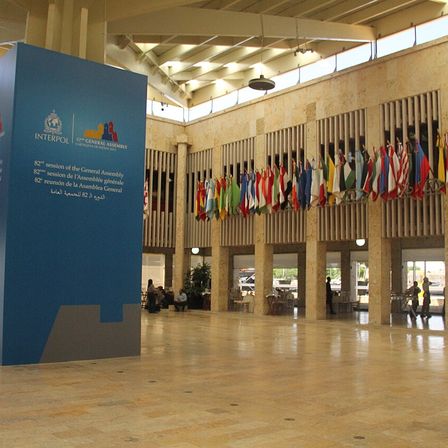
In practice, national platforms are a point of contact for cross-border work. INTERPOL reported in 2022 that, as set out in the Macolin Convention, national platforms centralise and analyse information on irregular or suspicious trends, and that strengthening intelligence sharing between them was a priority for its Match-Fixing Task Force.
Article 12 supports that exchange by requiring parties to facilitate information sharing among public authorities, sports bodies, competition organisers, betting operators and national platforms, and recipients must report back on the follow-up on request. Article 14 sets the limit: the treaty requires that anti-manipulation actions comply with data protection law and that data exchanges stay within the necessary minimum.